Webwoven
Webwoven is an explainable knowledge-graph game built for OpenAI Build Week.
Connect anything. Discover why it is connected.
Players travel from a known start to a known target by following real, named relationships. Every move answers not only where can I go? but why are these things connected?
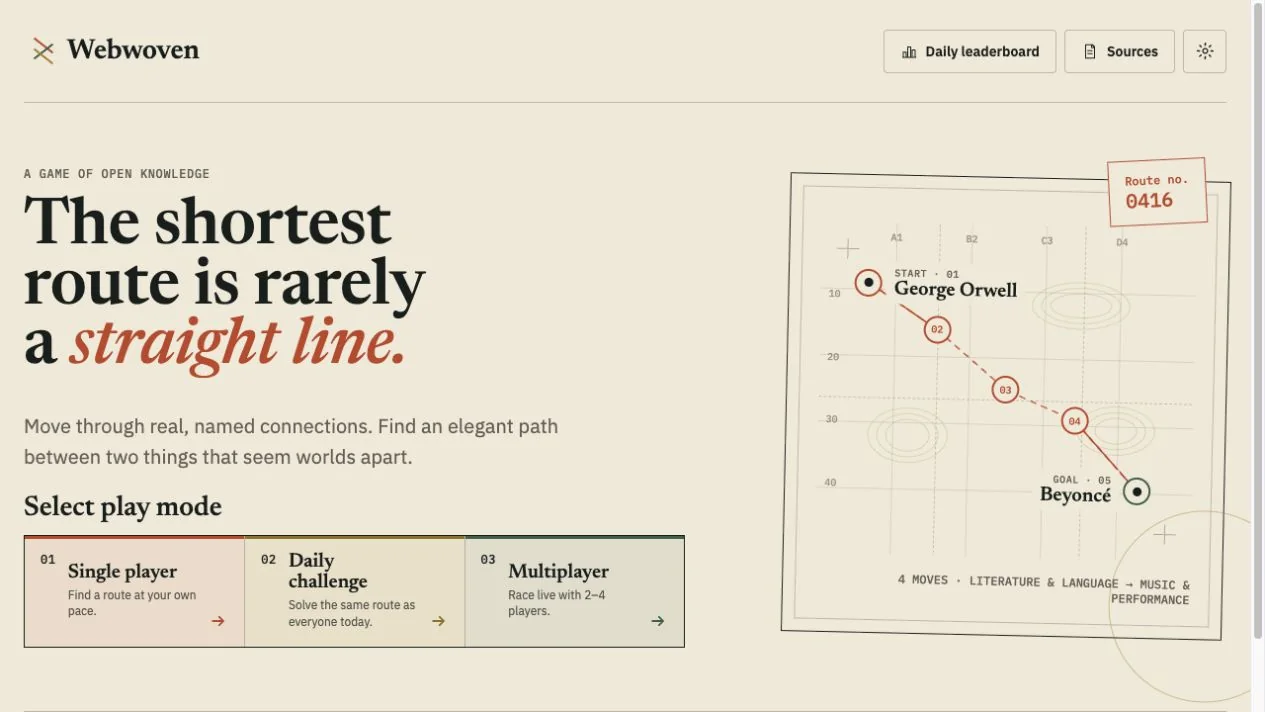
Three ways to play
- Single player for a difficulty-selected route at your own pace
- Daily challenge for one shared route and leaderboard
- Multiplayer for a synchronized live race with two to four players
Each mode uses the same immutable, explainable atlas. A player can inspect the documented fact, licensed image, and preferred Wikipedia article behind a node without spending a move. Automatic assignments begin with at least two distinct destinations, and every direction presents the same fact-aware relationship sentence.
Two promises
The product promise is a fair and visually distinctive knowledge game. The build promise is that everyone with an idea can become a game developer when an AI collaborator is paired with a clear brief, testable decisions, and visible human judgment.
The documentation is maintained with the implementation. It records architecture, data provenance, AI boundaries, tests, operations, and concise Build Week milestones.
Current milestone
Webwoven is live at www.webwoven.org halfway through Build Week. Single player, Daily challenge, synchronized Multiplayer, responsive route exploration, source inspection, and privacy-minimized reporting all run against an immutable, release-scale Wikidata bundle with locally served, policy-checked Commons media for every graph entity. The active atlas contains 3,970 entities, 22,402 named relationships, 100 validated, published choice-first routes, and ten categories. Every category offers four Easy, four Normal, and two Hard routes. The synthetic smoke graph remains test-only. The remaining release work is accessibility, security and load verification, content review, demo recording, and submission packaging.
Start with the game rules, system map, architecture, data pipeline, or the current build log.